MANTIC BLOG POST
Forecasting the Iran crisis in real time

Gabriel Fritsch
The pace of escalation in the US-Iran conflict has surprised markets and policymakers alike. In three weeks, it has cascaded from targeted military strikes to a wider regional conflict and the closure of the Strait of Hormuz, triggering the largest disruption to global oil supply in history and raising the spectre of a global stagflationary shock.
At Mantic, we are building a general AI superforecaster to predict the world’s most important issues. We currently have the strongest AI track record for prediction accuracy, placing 4th in a recent major forecasting tournament against human forecasters, which was covered by The Atlantic.1
The Iran crisis is therefore a live test of our system – this is the first major geopolitical crisis where advanced AI forecasting capabilities are available to generate predictions in real time.
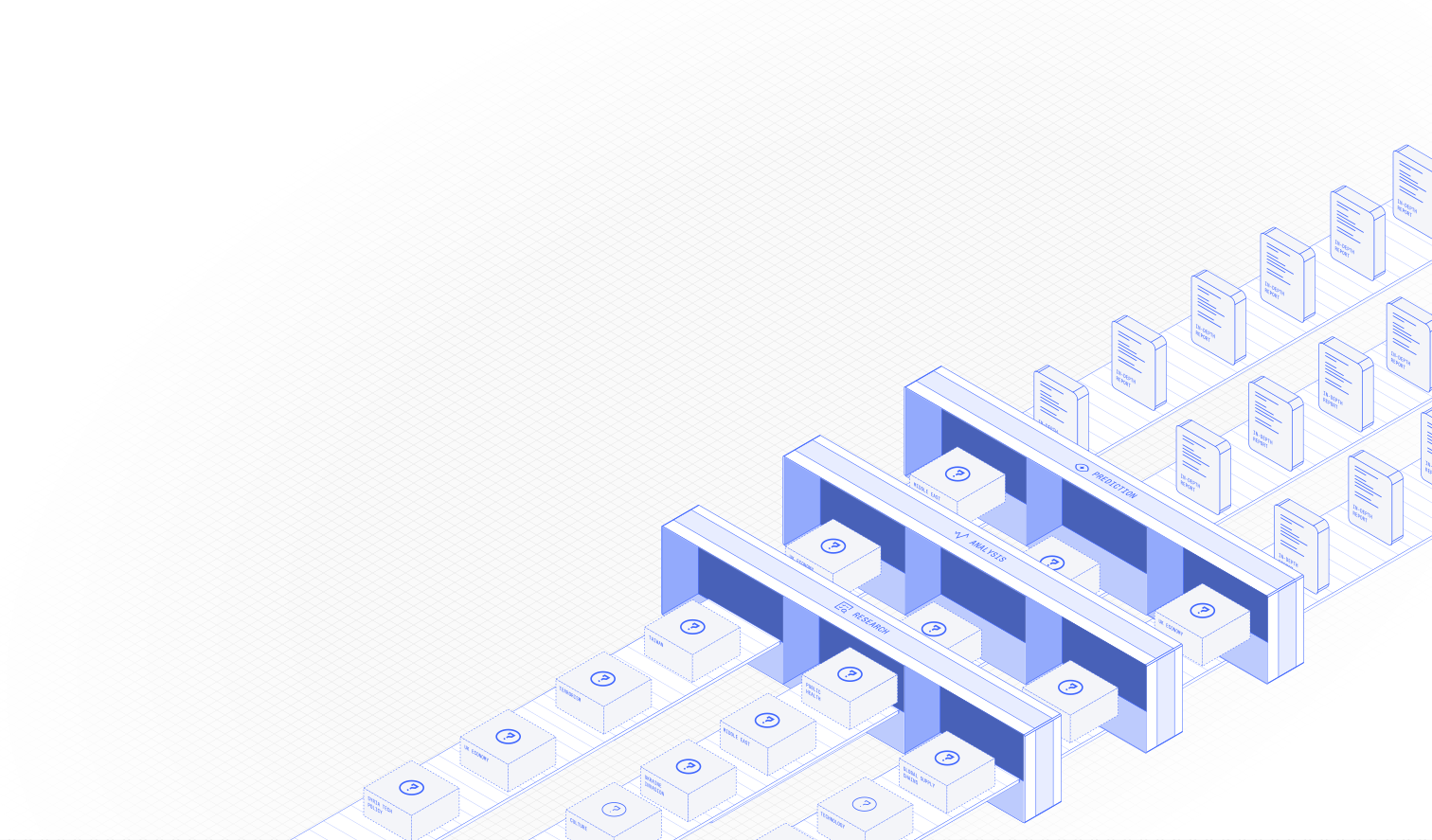
Mantic has been built to get predictions right, update them frequently, and automatically expand the question space as events unfold. So far, we’ve performed well across these three dimensions:
- Accuracy: on the questions that have resolved, Mantic’s forecasts held up well against outcomes and prediction markets.
- Speed: our “tripwires”, which monitor news sources and markets and trigger fresh forecasts when relevant developments are detected, have been running around the clock as the situation evolves.
- Scale: the system automatically generates new downstream forecasting questions as the crisis cascades into energy, shipping, and macro domains.
We break down the details below.
How has Mantic performed so far
The US strike
Prior to the initial attack on February 28th, Mantic had the probability of a US military strike against Iran at approx. 70% by mid-2026, comparable to prediction markets. The question was automatically identified and generated by the system on January 14. Unlike prediction markets, where a separate market is required for each deadline, Mantic forecasts events as a probability distribution over future dates, generating predictions of a given event happening by any date, over time, and providing a much more granular view of when something will occur.2
Case in point below. On the eve of the strikes, around midnight UTC on Feb 28, Mantic put the probability of the event happening at 15% over the next 24 hours. By 6:17am, just minutes before the news of the strike broke, Mantic’s tripwires triggered due to price moves in markets, updating its forecast to 48% for February 28. Its final rationale cited the large scale of US naval and air force deployments to the Gulf of Oman, with escalating executive rhetoric and a perceived window of Iranian regime vulnerability. It noted that while Gulf state airspace restrictions and 70% domestic opposition provided significant headwinds, the administration's 'locked and loaded' posture suggested the threshold for kinetic action had already been lowered.


Oil market disruptions
In the hours following the attack, Mantic’s forecast for the Strait of Hormuz closing to commercial shipping jumped from around 20% to 80%.3 The probability of a military attack on a commercial vessel in the Strait rose in parallel, reaching 83% by March 4, before the Safeen Prestige, a Malta-flagged container ship, became the first commercial vessel to be struck within the Strait itself.4


As the conflict escalated, Mantic started generating new downstream questions such as the probability of QatarEnergy declaring force majeure on its LNG contracts. The question was generated on March 1. On March 2, Iranian drone strikes at the Ras Laffan LNG facility led QatarEnergy to halt production, and Mantic updated its forecast significantly upwards to around 70%. On March 4, force majeure was declared.

Importantly, these questions did not have matching prediction markets. Mantic identified them as relevant and assigned accurate probabilities before any market existed to do the same.
What's next
As the crisis persists, here is where some of our live forecasts stand as of March 24.
Ceasefire or escalation?
Ceasefire prospects between the US and Iran by June 30 stand at around 75% by mid-year, up from roughly 60% over the weekend, following signals of a possible diplomatic off-ramp from the Trump administration on March 23. Mantic identifies the spring as the most likely window, with the median date in late April: the operational timelines for Epic Fury and Lion's Roar point toward an April conclusion of the high-intensity phase, Iran's missile capacity is roughly 90% degraded, and oil above $100 is creating pressure to prevent a global recession, particularly for the Trump administration ahead of midterm elections later this year. But the path to a ceasefire is complicated by several escalation risks that are still live.


The probability of a US or Israeli strike on Kharg Island — Iran's primary oil export terminal — has fallen to 3% by end-March following the announcement of a five-day pause on strategic strikes by the US, but remains at 25% by mid-year. Mantic views the main risk window beginning after the pause if Hormuz remains constrained or Iran escalates, though it notes that strikes on the island have so far deliberately avoided oil infrastructure: the maritime blockade has already halted Iranian exports, so destroying the facility would add environmental risk and further oil supply shocks for little additional strategic gain. US officials have also discussed seizing the island rather than destroying it, a move that would defund the regime while preserving the infrastructure for any eventual transition.


Any seizure scenario would require boots on the ground. Mantic puts the odds of a US ground deployment into Iran at 28% by June 30, down from 40-45% earlier this month as the diplomatic signals have shifted. The arrival of US Marines in the Gulf still creates a near-term window for amphibious operations — whether seizing Kharg Island or neutralizing other coastal infrastructure — but the administration's recent rhetoric suggests a preference for declaring victory through air power and economic pressure rather than a ground campaign. A majority of US voters oppose a ground invasion and broader coalition support from key allies remains thin, making anything beyond limited coastal operations unlikely without a months long build-up.
Regime change in Iran?
The Iranian regime has entered its most unstable period in decades. Mojtaba Khamenei was confirmed as Supreme Leader on March 8, but Mantic gives him a high (61%) probability of being removed by year-end, due to the combination of possible physical injuries sustained during the Feb. 28 airstrikes, active foreign targeting, and a lack of traditional clerical legitimacy.


President Pezeshkian's position has improved: during the succession crisis, our tool had him around 60% to leave office by mid-year, but this has since fallen to around 29% after he publicly aligned his administration with the new leadership. The regime collapse and elite purge scenarios have not materialised as quickly as feared, and Mantic now views him as more likely to remain in office — though hardline consolidation under Mojtaba still leaves a meaningful probability of early departure.
Energy supply
The center of gravity is the Strait of Hormuz, where commercial shipping has effectively ceased. Mantic forecasts a 59% probability that the Strait will reopen by June 30. This is down from ~80% two weeks ago. The economic pressure for reopening is immense, with over 20% of global oil supply choked off and Brent prices above $100, the status quo is unsustainable. Our tool sees two reopening pathways: a diplomatic off-ramp, with Oman-mediated talks now reportedly underway, or a military-enforced security corridor following the degradation of Iranian naval assets. But even after hostilities subside, a full normalization of commercial traffic will require minesweeping efforts and a restoration of war risk insurance, both of which could lag a ceasefire by weeks to months.


Physical infrastructure mostly survived the beginning of the war but came under the spotlight with facilities targeted on both sides in the past week. The probability of a major attack on Saudi or UAE oil facilities causing a disruption of at least 500,000 barrels per day rose to ~80% over the weekend but has corrected back to 45-50% following the five-day pause announcement.5 QatarEnergy's Ras Laffan facility was hit on March 18 with reports of extensive damage to key liquefaction infrastructure. The probability that QatarEnergy will lift its force majeure on LNG shipments by mid-year is now close to zero, given the scale of damage, the ongoing Strait of Hormuz blockade, and CEO al-Kaabi's explicit condition that production requires a total cessation of hostilities.


Global economic fallout
The energy supply shock is now propagating across the global economy. Mantic places the odds of Brent crude closing at or above $120 by mid-year at 49%, down from a high of 75% a week ago. Prices have already tested this level intraday but have pulled back following the strike pause and a record IEA strategic reserve release. The supply gap from the Strait closure remains on the order of 17 million barrels per day but the outcome now hinges largely on whether the current diplomatic window produces a de-escalation or collapses back into strikes on energy infrastructure.
For global monetary policy, the crisis presents a stagflationary dilemma. In the US, a weakening labor market would normally invite cuts but the risk of energy-driven inflationary pressures mean that the probability of a Fed rate cut at the June meeting has fallen to 10%. Prediction markets seem to agree, and Mantic has generally put a higher probability than markets on this hawkish tilt over the last weeks. The ECB's position is starker. The probability of a rate cut in June sits at just 3%, with a >70% probability of a hike. The energy price shock has effectively ended the easing cycle in Europe.


Navigating an uncertain world
Most of the questions in this post did not exist a month ago. As the crisis cascaded from airstrikes to energy disruptions to monetary policy, Mantic generated them, assigned probabilities, and monitored for updates 24/7, in real time, in many cases where no prediction market existed. The world is becoming more complex and more fragmented. We are building to help decision makers navigate this uncertainty.